Device physics to dependable sensing at scale.
Faculty, Centre for Sensors, Instrumentation and Cyber-Physical System Engineering (SeNSE)
Director, INTRINSIC Lab (Intelligent Robotics and Rebooting Computing Chip Design Laboratory) | IIT Delhi
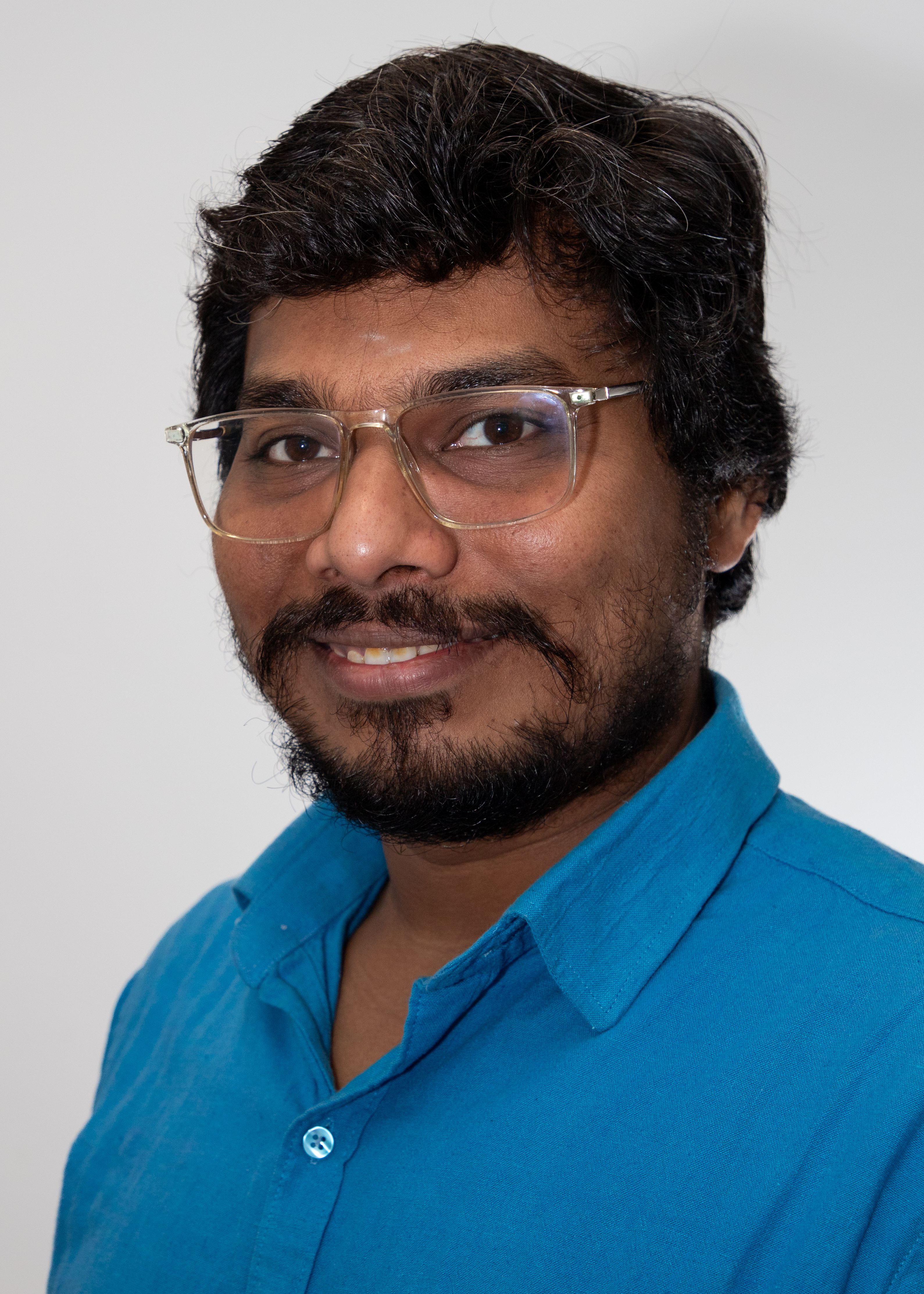
Faculty, Centre for Sensors, Instrumentation and Cyber-Physical System Engineering (SeNSE), IIT Delhi
Prof. Santhosh Sivasubramani is faculty in the Centre for Sensors, Instrumentation and Cyber-Physical System Engineering (SeNSE) at the Indian Institute of Technology Delhi and Director of the INTRINSIC Lab (Intelligent Robotics and Rebooting Computing Chip Design Laboratory). He leads interdisciplinary research that engineers sensor-rich cyber-physical systems by tightly integrating materials, devices, instrumentation, robotics, quantum-enabled elements, and system-level architectures to deliver energy-efficient, robust, and secure sensing and computing for real-world deployments in defense, healthcare, space tech, robotics and emerging technologies.
PhD project abstract: Rebooting computing using Magnetic Quantum-dot Cellular Automata (MQCA). The work developed nanomagnetic logic architectures and micromagnetic simulation pipelines to design area-, speed- and energy-efficient convolution and arithmetic primitives that exploit non-volatile magnetic states. Developed runtime reconfigurable nanomagnetic architectures and hybrid approximate nanomagnetic designs by exploiting shape and positional anisotropy of nanomagnets alongside ferromagnetically coupled fixed input majority gates for beyond-CMOS computing and resource-constrained artificial intelligence on edge. Article recognized by IRDS in Beyond-CMOS reports.
MTech project abstract: Experiment and simulation study of electronic transport and magnetic properties of graphene for nanoelectronic applications. Fabrication and characterization of graphene interconnects demonstrating graphene as a strong candidate for clock and check lines in MQCA frameworks. Contributed to graphene nanopattern fabrication for nanomagnetic computing applications while exploring AI-based structural health monitoring using robotics. Worked on DEITY Government of India sponsored project "IoT for Smarter Healthcare" at Centre for Cyber-Physical Systems & IoT, IIT Hyderabad, investigating 2D material graphene for CPS-IoT enabled solutions.
Bachelors project abstract: Design of an intelligent fuzzy-logic robot for power system monitoring and protection integrating multi-sensor sensing for fault detection and protective actions in high-security environments. The overarching vision revolves around developing ultra-low-power computing platforms for macro and nano robotics applications in defense, energy, mobility, biomedical assistive technology, and space missions.
Postdoctoral work advanced secure and reliable computer architecture (integrated chip) design toward rebooting computing for AI applications. Explored interlayer exchange coupled nanomagnetic arithmetic architecture design methodologies with experimental validations. Subsequently published on skyrmion-based 3D low-complexity runtime reconfigurable arithmetic architectures. Developed expertise in architecture design methodologies for Tsetlin Machine enabling energy-efficient portable machine learning algorithm deployment in edge integrated chips.
As part of APRIL AI Hub, developed comprehensive AI-driven inverse design frameworks for memristive skyrmion logic elements combining supervised learning with reinforcement learning, advancing the bidirectional integration of AI for skyrmions and skyrmions for AI with roadmaps, deliverables, and software tools.
I am motivated to translate intrinsic material and device behaviors into dependable engineering systems that solve real-world sensing and autonomy challenges.
We co-design sensors, instrumentation, materials, and computing architecture so that intrinsic device properties become functional primitives for energy-efficient, robust, and secure cyber-physical systems.
YFIF (Young Faculty Incentive Fellow): Recognized for outstanding research contributions as young faculty.
IRDS Beyond-CMOS Working Group Report: Contributor to the International Roadmap for Devices and Systems (IRDS) Beyond-CMOS working group reports.
IMEC Belgium Research Visit: Member of Beyond-CMOS Benchmarking Team at IMEC, Belgium.
IEEE Senior Member: Holding various leadership roles at Section, Council, Region, and MGA levels.
Visiting Fellow: UKRI APRIL AI Hub, Centre for Electronics Frontiers, School of Engineering, University of Edinburgh.
Generative AI-powered educational platform for personalized learning with adaptive assessments and real-time feedback.
Launch Platform → 🔒 Protected AccessGPU-accelerated micromagnetic simulation platform for synthetic antiferromagnets and neuromorphic computing devices.
Documentation → GitHub v2.2.0 | Open SourceProof-of-concept deployment demonstrating neuromorphic computing applications.
View Demo → 🔒 Protected AccessQuantum machine learning and hybrid classical–quantum computing resources, tools, and documentation for research and education.
Explore → 🔒 Protected AccessMulti-scale learning engine for neuromorphic spintronic devices — simulation, training, and inference platform for spin-based neural hardware.
View Platform → 🔒 Protected Access